
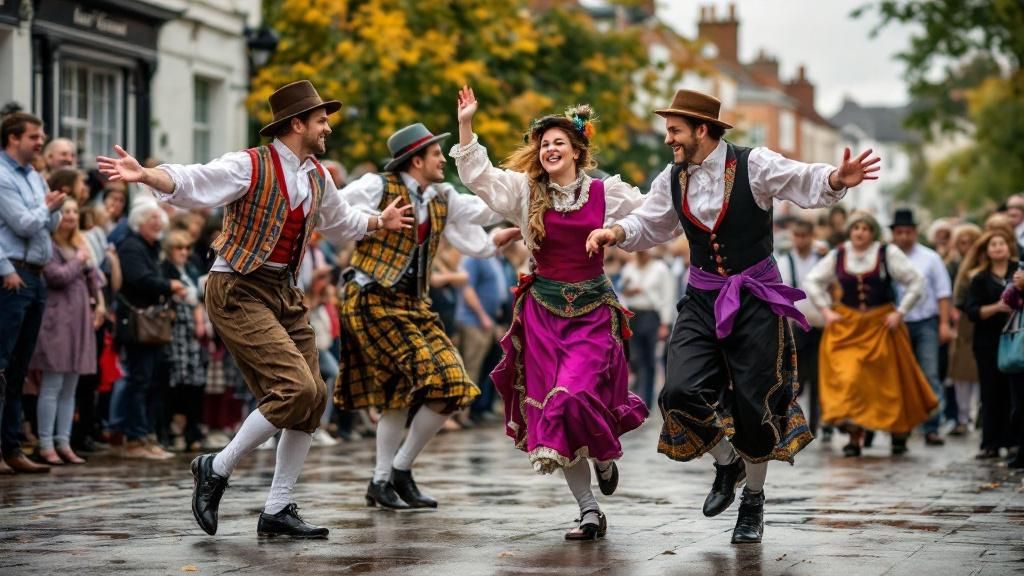
Once overlooked as a charming remnant of England’s countryside traditions, Morris dancing is witnessing an remarkable comeback amongst Britain’s youth. From student groups to country spaces, enthusiasts under the age of thirty are reconnecting with the patterned movements, tinkling bell accoutrements, and colourful costumes that have shaped this long-established practice. This article examines the reasons behind this heritage revival, examines how modern dancers are reworking the tradition, and considers what this revived engagement reveals about modern British perspectives towards tradition and social connection.
The Revival of Morris Dancing
The revival of Morris dancing amongst younger British communities demonstrates a remarkable departure from decades of declining participation. What was once viewed as an strictly countryside or aged pursuit has transformed into a vibrant cultural phenomenon, with university groups, metropolitan dance collectives, and community organisations genuinely championing the tradition. This comeback disrupts established stereotypes and shows that contemporary youth find genuine value in preserving and celebrating Britain’s traditional heritage, reinvigorating practices that appeared headed toward obscurity.
This revived interest goes further than basic heritage nostalgia; young performers are deliberately transforming Morris dancing for today’s world. They integrate current musical styles, experiment with innovative choreography, and create welcoming groups that embrace dancers regardless of heritage or previous training. The movement demonstrates a more expansive cultural transformation wherein British youth actively pursue authentic connections to their heritage whilst at the same time reshaping the meaning of tradition, fostering a ongoing exchange between heritage fidelity and modern artistic interpretation that connects with what matters to their age group.
Why Young Adults Are Taking Up This Time-Honoured Craft
Morris dancing’s appeal to younger generations transcends nostalgic curiosity. Contemporary dancers appreciate the art form’s substantial cultural legacy whilst valuing its capacity for creative expression and social connection. The ease of access to modern Morris groups, coupled with their welcoming approach, has reshaped the perception of this traditionally insular pursuit. Young people are realising that Morris dancing provides a worthwhile substitute to standard recreational pursuits, providing both demanding physicality and authentic social connection in an increasingly digital world.
Community Connection
In an era characterised by social fragmentation, Morris dancing groups offer young people with concrete social networks rooted in common principles and joint participation. The welcoming character of contemporary Morris organisations readily embraces newcomers regardless of background or experience, fostering authentic bonds and social bonds. Participants often describe their dancing cohorts as family units of choice, providing emotional support and belonging that stretches well beyond the dancing calendar. This communal feeling proves particularly valuable for young adults managing the shift from education to work.
The cooperative design of Morris dancing inherently fosters collective togetherness and mutual responsibility. Each dancer’s input directly affects the group’s synchronized appearance and temporal accuracy, creating mutual reliance that deepens interpersonal connections. Many young dancers note that their Morris groups foster authentic connections in ways that conventional social settings regularly fail to deliver. The joint investment to maintaining and developing this cultural tradition creates a powerful sense of collective purpose amongst participants.
Bodily Activity and Health and Wellness
Morris dancing requires substantial bodily effort, blending cardiovascular exercise with intricate movement control and muscular conditioning. Young dancers gain enhanced physical capability whilst participating in activity that carries cultural significance rather than merely utilitarian. The rhythmic, repetitive nature of Morris footwork offers meditative qualities alongside physical conditioning, contributing positively to mental wellbeing. Participants frequently cite the holistic health benefits as a primary motivation for continued participation in their local Morris groups.
Beyond cardiovascular benefits, Morris dancing cultivates body awareness and spatial perception and bodily confidence, especially beneficial for adolescents struggling with body image concerns. The focus on accuracy and technical skill and collective synchronisation shifts attention away from appearance-based anxiety towards competence and accomplishment. Furthermore, the outdoor performance tradition connected to Morris dancing prompts people to connect with the natural world and seasonal rhythms, supporting mental health through connection with the natural world and cultural heritage.
Regional Variations and Modern Adaptations
Morris dancing practices differ considerably across Britain’s regions, with each region establishing distinctive styles reflecting community traditions and landscape. The Cotswolds preserve the vigorous, athletic “Cotswold” style, whilst the North West prefers the highly detailed “Northwest” tradition showcasing elaborate costumes and detailed arrangements. New generation dancers are actively adopting these local styles, engaging in instruction and festivals to master authentic techniques whilst understanding the subtle cultural elements embedded within each tradition. This geographical diversity gives modern dancers with various pathways into Morris dancing, helping them connect with history embedded in their local areas.
Modern adaptations are simultaneously broadening Morris dancing’s reach beyond traditional contexts. Younger practitioners integrate contemporary music, experimental choreography, and inclusive casting practices, questioning historical gender and age restrictions. Mixed-gender sides and LGBTQ+ Morris groups have developed, fundamentally transforming the tradition’s social dynamics. These innovations maintain the essential character—rhythmic footwork, bells, and celebratory spirit—whilst rendering the practice more accessible and relevant to contemporary participants. Such creative reinterpretation illustrates that heritage traditions need not remain static, successfully connecting historical authenticity with modern sensibilities.
The Future of Morris Dancing in Britain
As Morris dancing continues to captivate younger audiences, the tradition stands at a pivotal juncture. Contemporary dancers are consciously redefining the form whilst respecting its traditional roots, bringing new dance moves and welcoming approaches that appeal to modern sensibilities. Universities document unprecedented enrolment in Morris societies, whilst festivals draw record crowds of young participants. This momentum suggests the art form is evolving past nostalgic curiosity to authentic artistic renaissance, establishing sustainable foundations for continued expansion and continued relevance within British communities throughout the UK.
Looking ahead, Morris dancing’s trajectory appears notably encouraging. The convergence of social media promotion, straightforward instruction approaches, and younger generations’ appetite for authentic community connection creates ideal conditions for flourishing. Organisations are supporting apprenticeship schemes and local contests, fostering talent pipelines and ensuring knowledge transfer between experienced and novice dancers. Should this enthusiasm continue, Morris dancing may finally move beyond its image as exclusively tradition-centred, instead becoming recognised as a dynamic, developing art form that genuinely improves contemporary British society and reinforces community ties across generations.
